Monday, June 28, 2010

Country Home

Last September I did a whirlwind tour of two research locations in eastern Oklahoma and two in Arkansas. We were putting together a new team effort that would combine their research efforts to find ways for those land owners who have small farms but have to work elsewhere to make a living because they cannot make enough off other their own land. While driving on a freeway between Fayetteville and Booneville, I thought about the concrete trail cut through the mountains was the result of Federal highway funds - appropriations - that knitted together our interstate transportation network - if it wasn't for the Federal government, where would a small state like Arkansas get the resources to build its share. Earlier in the day I had met with various administrators at the University of Arkansas and discussed research with scientists at their laboratories. The next day I toured the facilities at another research center that served the needs of rural communities with small-scale farms. Here too the state participates as a member of a larger country.

In the spring of 2006, I had visited similar facilities in West Virginia - again, with a mission to serve the needs of farmers and ranchers who may not be as advantaged as those in the big agricultural states, or those states that have access to ports and a large industry base. Common to those places were researchers who are motivated to make a difference with their work - to help farmers and rancher make a better living off of the land their families may have owned for generations.

The way the founding fathers devised our government representation - two Senators from every state, the number of Representatives based on a state's population - has made it possible for those states that do not have as great a population or as great a resource base as the those with coastlines to move forward together with the rest of the nation - pro and con perspectives - the intent of the Constitution's drafters and the unforeseen consequences. Today Senator Robert Byrd died. He was one of those members of Congress who watched over his state - saw to it that West Virginia benefited from the bounty of our greater nation - a price of and value from membership for all states in the Union. The hand prints of long-term representation continue, just as the music that may still echo through the mountains where ribbons of concrete reach around mountains and bridges of steel ford rivers.

Saturday, June 26, 2010

Hot and Humid Saturday

I have been trying to figure out the less descriptive birds in our yard - the sparrows. Among the varying combination of shades of grayish breasts, darker or lighter head stripes, different spots and streaks (and don't forget to throw in male and female and immature differences), there were two finalists species to choose from that resembled the specimen I have been noticing off-and-on coming to our feeder for a good part of this summer - Harris Sparrow or Lapland Longspur. Both are more showy than most of the sparrow-like birds we encounter.

Earlier this evening we wanted to get out of the house, so we took what turned out to be a short trip to City Dock. Today was at least 88° F and 70% humidity, and there was lots of traffic heading down Compromise Street over the Spa Creek drawbridge - from experience we have learned, this is not a good sign - hard to find parking, our driver pass onto the Naval Academy Yard has expired, and it is sure to be crowed with people. Since it was not all that great of weather, we figured why not turn around, drive to the Giant grocery store in the neighborhood and pick up ice cream, and go home and enjoy it there. After watering down the patio to cool things some more, we sat and ate our cool desert. As we watched the slow stream of birds come-and-go while the sun set behind the trees - the unknown appeared.

Out came the binoculars for a close examination...Black face outlined with white...Rusty collar...page 308, Peterson's Birds of Eastern and Central North America...identification confirmed...Lapland Longspur (Calcarius lapponicus), not the Harris Sparrow. The only character I haven't been able to see, the long talon spur - it is hidden by the trough that doubles as a perch on the feeder while where the birds perch, and the birds won't let me get close enough to see from a better angle.
_________________________

The Song Sparrow
Another positive ID this evening was a Song Sparrow (Melospiza melodia). Page 200 of Peterson's field guide: 5-6 1/2 " (13-16 cm) Note heavy breast streaks confluent into a large central spot. Long tail. SIMILAR SPECIES: (1) Savannah Sparrow (p. 302) is more of a field bird; it often shows yellowish over eye, has a shorter notched tail, pinker legs. (2) See Lincoln's Sparrow (below). (3) See Swamp Sparrow (p. 296) VOICE: Song, a variable series of notes, some musical, some buzzy; usually starts with 3 or 4 clear petetitious notes, sweet sweet sweet, etc. Call note, a low nasal tchep. RANGE: Alaska, Canada to cen. Mexico. HABITAT: Thickets, brush, marshes, roadsides, gardens.

Earlier today, a couple of commons: swallow tail butter fly on the butterfly bush (a), and a bumble bee on echinacea (b). This is the first year we have had these prairie wildflowers bloom - not an extra-ordinary one, the common Magnus. Lastly (c), a daylily my mom received from her cousin, a renowned developer of daylily varieties. His son and I work for the same agency. We dug up the crown in our Oregon garden and and brought it to Maryland - this is the best bloom we have had since planting it here. But then, everything seems to be growing better this year - functioning drip systems with frequent supplemental watering, didn't take a late-June trip to the West Coast this year (that greatly enhances the supplemental watering), and lots of work put into the yard earlier getting ready for Commissioning Week and all of our visitors.
_________________________

Will June end up warmest on record?
If the weather keeps up like this for the next few days, we will end up having the warmest June in Annapolis on record (1). Plenty of sunshine and warmth to make things grow really fast in our garden, but as for us, we will have to stay inside as much as possible to keep from wilting, and so we will have to wait until after the sun goes down to watch the birds - while eating our ice cream.
_________________________

(1) According to an article in the next-day Sunday morning Annapolis Capital newspaper (see the third of three briefs). (2)

BWI AIRPORT - This month may end up the warmest June on record if the forecast for the next couple of days holds true.

The high today was expected to flirt with the century mark in parts of the Baltimore metropolitan area, with temperatures likely to be hitting at least 97 or 98 degrees.

The 100 degrees on Thursday at BWI Thurgood Marshall Airport was easily the hottest day of the year and broke by 2 degrees the record set in 1966. It was the hottest day in three years.

Friday's high reached 93 degrees and yesterday's was 94, the eighth consecutive day in the 90s and the 13th 90-or-above day this month, according to the National Weather Service. The record for 90-degree days or above in June is 18.

The high three other days hit 89 degrees and 88 on two more, bringing the daytime temperature to nearly 7 degrees above normal.

Forecasters also are calling for a high of 94 tomorrow with a chance of thunderstorms as a cold front approaches. Tuesday's high is expected to be 89, with a drop to 84 on Wednesday as the front pushes through the region.

Last week's heat wave was blamed for the death of three Maryland residents, all of them elderly.

(2) June is past, July is here - just missed the record.

Tuesday, June 22, 2010

Dawn Treader, Christmas 2010

This is an update to an earlier blog. The Voyage of the Dawn Treader will be at the theater December 10th.

The Website.

The Facebook site.

Wall Street Journal site.

Sunday, June 20, 2010

Lots of Attraction

In the latest issue of Fine Gardening, "Making the most of a small space," the author makes the point her garden is a reflection of her life - full and varied. While most gardening magazine articles make a point of the plants and hardscape that are in various private and public spaces, I like to constantly think about how the wildlife that is a part of our yard is also a part of the flowers, trees, shrubs, beds, and paths. As the blooms of different plants flower throughout the season, I am keeping track in my head the changes in animals, particularly birds, that appear. I know that migratory patterns also affect these (1), so I am sure that as time goes by and I pick up more bits of information, the more I hope I will understand.

Keeping an inventory - maximum counts the numbers of what-ever's are in the yard at one time - is the latest addition to my keeping track of the juxtaposition of plant and animal elements in the yard. This morning a new record for our yard was set for squirrels - four eastern gray squirrels (Sciurus carolinensis) (a) and one black squirrel (b). Last week I counted at least 15 bumble bees at one time on the many spikes of flowers in the stand of lavender next to our patio (c). They are ever present and active from morning to evening, and we watch them while eating breakfast, lunch, or dinner at the patio table. They never bother us, and seem to be totally unaware of us or our meals. The common grackles can be nearly as dense as the bumble bees - a couple of weeks ago I counted 12 on, below, and above the bird feeder. When they are in their messy prime, they can shovel through an entirely full feeder in one day. That probably contributes as much towards the high density of squirrels in our yard as anything else.

I would be remiss if not noting some of the most prolific flowering plants in our garden; there many coreopsis (d) blooms - the greatest number we have had since planting small pots of them two years ago. The black-eyed Susan's are about to pop, but the coreopsis always beat them to the bloom. There are several kinds of daylilies planted around the yard - some the previous owners had planted along the fence with our neighbor John under the climbing roses, and others the ones we brought as mementos from our Oregon garden (e). We also have multiple hanging flower baskets planted with annuals (f and g), five of them this year, but still not nearly as many as we had out west.

Friday, June 18, 2010

It's Not a California Condor, but....

In a recent blog I mentioned that the most common bird I saw on a recent road trip from Maryland to Florida and back was the Black Vulture. Well, today before leaving for work we heard a thump noise outside.

My wife asked, "What was that?"

"A squirrel running on the roof?", I said.

She didn't buy that. I went outside in my bare feet with my socks and shoes and sat at the patio table to put them on - it was a nice morning, and that gave me a chance to enjoy the morning outside before commuting to work, if even for a minute.

As I pulled out a chair, and as I looked up to my left above the kitchen window, there was a Black Vulture perched on the retractable awning. A magnificent creature (1), the largest bird to-date we have seen in our yard. I was so close, I could see the rows of wrinkles and small feathers around its head, while it sat still and hunched slightly over at its neck above the shoulders. I called for Jan to bring my camera, "...and hurry."

She came to the door, and as I said there was a vulture sitting on the awning, she reached out with only her arm to hand me the camera. She shuttered and made the point she wasn't going to come outside.

"Is it here to eat the little bunnies?" (2)

"No, it only eats carrion."

"What does that mean?"

"Only dead things."

"I'm not coming out there."

I took a few shots, and then changed the camera setting to video and walked slowly toward the bird - it had flown to the fence between our and John's yards. As I got closer, it flew down into the next-door yard, up to the neighbor's fence, and then away.

That was that, and Jan still didn't want to come outside until I assured her it was gone.

"Check the trash, it is in the street."

For sure, black vultures don't eat live animals - they will frequent road-killed carcasses. But now I have documented proof that they are suburban dumpster divers as well, or at least will tear into a plastic garbage bag left out on Thursday night for Friday pickup by the Annapolis waste collection crew.

The bag had been dragged out into the middle of the street and torn open. I was pretty sure the expired fluorescent light bulb was not the target, or various other kinds of trash. Chicken drumstick bones - yes, those were the most likely target - scraps from the the night-before's meal - extradited from the bag and scattered on the pavement.

As I was crouched down and lining up the right angle to take a picture documenting my discovery, my neighbor Raffi from across the street was walking his dog (3) and asked, "What happened?"

"A black vulture got into the trash," I said matter of factually as I stood up after snapping the shot while putting the camera in my pocket.

"So what do you do?", expecting a reply that had to do with reporting the incident to the Environmental Protection Agency, or maybe even the home owners' association.

"Pick up the trash," I said, as I opened a new trash bag and began cleaning up the mess.

Fifteen minutes later I was at the wheel, dialing my appointment on the cell phone, and on my way.
________________________________

Not So Dark Vulture

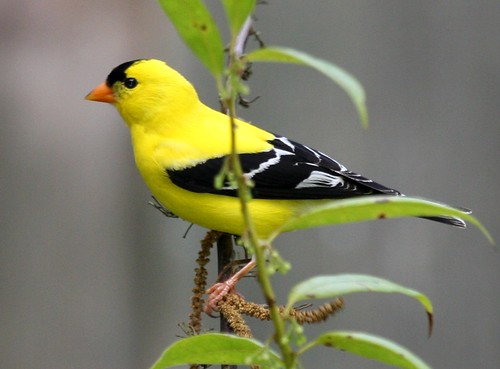
The depiction of a vulture imitation by Snoopy in the Charles Schultz comic Peanuts is probably the only time one can be consider a vulture "cute." It is no wonder my wife wanted nothing to do with the specimen in our backyard. Interestingly, the bird returned this morning after I left, and was drinking water out of a bird bath bowl on the ground between the awning above the kitchen window, and the fence mentioned earlier. She reported she tried to get a photo for me, and seemed pretty proud of having tried. Maybe if the vulture becomes a regular visitor to our yard like the other birds we know, my wife will become more endeared to our very dark-colored-large friend, much like she is to our American Goldfinches and Northern Cardinals - the most yellow and most red birds in the universe.
________________________________

(1) There are a few things in natural history that have deeply made me sad when when I realized what had changed. The first time was about 10 years ago when I saw stands of native grasses and other vegetation in a Yolo County Resource Conservation District restoration project in the Sacramento Valley - I had read about and collected specimens of California native grasses as a teaching assistant, but had never seen anything like this relic of the past, knowing that 250 years earlier these were the norm; the second was when reading The Eternal Frontier three years ago that some woolly mammoth may have lived until 4,000 years ago; and the last time when reading a biography about the plant explorer David Douglas, that he observed California Condor when traveling the Columbia River. Thinking about what has changed could make me sad if I sat still long enough to think about it - the lyrics and music of Neil Young's Natural Beauty - haunting sounds in my ears.

(2) See yesterday's blog. Our backyard and entire neighborhood is full of little cotton tail rabbits. There are about as many of them around, as there are fireflies at dusk - well, not quite as many.

(3) The dog's name is Camden, like the name of the Baltimore Oriole's ball park at Camden Yards.

Thursday, June 17, 2010

First Spotting/Hearing of the Year

We were having dinner on the patio this evening - what we do most evenings as long as the weather is nice - when there was a flash to the left of us toward the kitchen window. We could see that it was a relatively large insect, which then disappeared toward the trees and shrubs along the fence with our neighbor, John. After a short discussion about "what was that, a Japanese Beetle?" We were just talking about why our crepe myrtles had not yet bloomed and after learning a couple of weeks ago from Jan's brother who lives in Charlotte that those bugs (1) love crepe myrtles - we heard the distinct rapid fire rhythm sound of the cicada. They show up each year around here, and we don't know when the next seven-year cycle will happen - maybe this year we will experience the hoard of these larger-than-usualinsects. It hard to tell what the season will bring, man-eating cicada, or man eating cicada.

This follows by a few weeks the appearance of our first fireflies - only one at a time, it seemed - but this evening there are many hoovering over the lawn that has as much white clover growing in the turf among the tufts of grass. I probably should keep a better journal of what and when different critters appear around here. It has also obviously been post-birthing time for the cotton tail rabbits here - we have a mother and three kits (2). We also keep seeing the Eastern Box Turtles, and the diversity of birds keeps up increasing at a nice pace - especially as we keep up with filling the bird feeder with seed.
__________________________________

A cicada (pronounced /sɪˈkɑːdə/ or pronounced /sɪˈkeɪdə/) is an insect of the order Hemiptera, suborder Auchenorrhyncha, in the superfamily Cicadoidea, with large eyes wide apart on the head and usually transparent, well-veined wings. There are about 2,500 species of cicada around the world, and many remain unclassified. Cicadas live in temperate to tropical climates where they are among the most widely recognized of all insects, mainly due to their large size and remarkable acoustic talents. Cicadas are sometimes colloquially called "locusts",[1] although they are unrelated to true locusts, which are a kind of grasshopper. They are also known as "jar flies". Cicadas are related to leafhoppers and spittlebugs. In parts of the southern Appalachian Mountains in the United States, they are known as "dry flies" because of the dry shell that they leave behind.
__________________________________

(1) Cicada are true bugs, in the order Hemiptera. To the layperson, a bug is a bug is a bug, all insects are bugs. But to the highly trained professional - or folks like me who got a C grade in economic entomology - the different kinds of insects are classified by different morphological characters and grouped into orders. Hemiptera is the Order for true bugs.

(2) It was dusk, so the lighting was not very good, but the mother rabbit was nursing two of the kits. The third had run to the other side of the yard while we were watching. The kits nurse on their backs - suckling up. The doe spreads here front leg while sitting on her haunches to accommodate her litter.

Friday, June 11, 2010

First Atlantic Bird Sightings

I don't know sea shore birds at all - only paying attention to those of fields and forests. On the recent road trip, I had the opportunity to identify my first shore bird while waiting in line for the Fort Fisher-Southport Ferry (1). The birds were flocking all over the parking lot in an Alfred Hitchcock'esque manner, much in part due to the lady in the car next to our car who kept throwing bread crumbs out her window - some even hitting the side of our car - mouthing "Oh, excuse me" and then kept on doing it.

Calling for my trusty copy of Peterson's A Field Guide to Eastern Birds, I had no clue what I was looking at. I turned through the pages of Terns, Petrels, Shearwaters, and Gannets. What are these critters? We only had to wait five minutes for the 5:30 ferry, so were quickly on board and parked. The birds followed us, or the lady throwing the bread crumbs. Finally, with time to spare, and magnification of one of the photos I took in the queue... the Laughing Gull, or is it a Black-headed Gull? Finally, it was sure - a Laughing.

It just happened that there was a news report on the radio that birds in the Gulf of Mexico being rescued included Laughing Gulls, with an image of an oil-coated one making the rounds. Cool looking birds in real life. At ease on ferry docks and decks and around people - willing to strike a pose like fashion models, and only for bread crumbs. The coincidence of making my first identification in the same day as seeing ones soaring over me, and hearing about ones held earth-bound in oil is ironic. The politics of the blame casting goes on about the Gulf spill - at least today another player was brought into the mix at whom to have stones thrown.
_________________________________

As we drove down the coast, there were many estuaries in Georgia that I pictured myself navigating through in a kayak - silent, anticipating what I would see around the next bend. Only a dream, but something to do some time in the future. For this trip, I was only able to do the window survey along the highways. The most notables were Red Wing Blackbird, Wood Stork, and possibly a Whooping Crane - though that would be a rare find given any along the Atlantic coast have been re-introduced. The black wing tip on the Whooping Crane distinguishes it from the Wood Stork which has a continuous black margin - also visible from below when in flight. The most common bird I saw from Maryland to Florida was the Black Vulture.
_________________________________

(1) See the map of the route to Fort Fisher-Southport Ferry between Wilmington, North Carolina and Myrtle Beach, South Carolina on Route 421.